The Hard Logic of Soft Power: Reimagining India–Japan Cultural Diplomacy
Posted on: 04 Oct 2025
in Editorials & Opinions
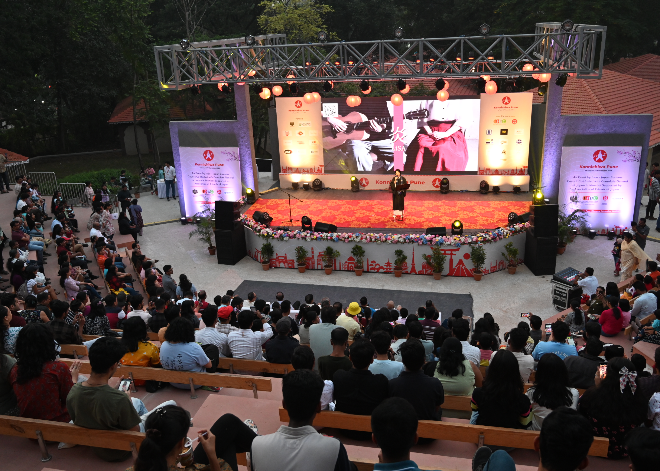
Konnichiwa Pune 2024
When we speak of diplomacy, we usually think of summits, treaties, and trade agreements. But the foundation of durable ties is often built in quieter ways — through culture, education, and people-to-people contact. For India and Japan, two ancient civilizations now navigating the turbulence of the 21st century, cultural diplomacy is not an afterthought. It is a strategic asset. Soft power, when nurtured deliberately, becomes hard strategy.
From Ancient Currents to Modern Platforms
This is not new. In the 8th century, the Indian monk Bodhisena traveled to Nara to preside over the consecration of the Great Buddha at Tōdai-ji — a moment that symbolized India’s spiritual influence in shaping Japan’s identity. In the 20th century, Rabindranath Tagore’s visits inspired cultural dialogue with Japanese thinkers, while Justice Radhabinod Pal’s dissent at the Tokyo Trials became a lasting emblem of trust between the two nations.
These examples remind us: cultural diplomacy sustains even when geopolitics shifts. Today’s platforms — from Konnichiwa Pune, now entering its 7th edition, to city-level partnerships — are the modern extensions of those historic bridges.
From Festivals to Frameworks
Konnichiwa Pune began as a local celebration of Japanese art, food, and dialogue. It is now one of the largest Indo–Japan cultural gatherings in India, attracting thousands of visitors, connecting businesses, and deepening public familiarity with Japan.
But Konnichiwa Pune is more than a festival. It has become a platform where cultural trust leads to institutional ties. The Pune–Okayama sister city agreement (2016) is a case in point: first came years of exchange, then came formal recognition. This is how soft power transforms into hard diplomacy.
Established Partnerships, Real Outcomes
- Other India–Japan partnerships illustrate this evolution:
- Varanasi–Kyoto (2014): heritage conservation and riverfront renewal.
- Ahmedabad–Kobe (2013): port-city and SME collaboration.
- Hyderabad–Hiroshima (2019): IT and peace education linkages.
Each demonstrates that cultural familiarity precedes political or economic agreements. Trust built through festivals, exchanges, or shared memory makes MoUs and investments more natural.
Why Soft Power Matters Strategically
Skeptics may dismiss culture as “soft.” But in a world polarized by rivalry, soft power is what anchors stability.
- Trust Before Trade: A Japanese investor in India feels reassured when cultural familiarity already exists.
- Countering Narratives: Unlike transactional or coercive models of engagement elsewhere, India–Japan ties are values-driven.
- Subnational Resilience: City and prefecture ties outlast shifts in central politics, sustaining momentum at the grassroots.
We already see the impact of cultural familiarity in daily life. Japanese language learning, once limited to a small circle of enthusiasts, has multiplied across Indian universities and private institutes. Indian visitors to Japan are at their highest levels ever, and cultural festivals like Konnichiwa Pune draw growing audiences each year. These flows of learners, travellers, and communities are not just feel-good exchanges. They are living proof that cultural trust quietly builds the foundations on which trade, investment, and diplomacy stand.
Japan itself has shown how culture can be wielded strategically — from the Fukuda Doctrine (1977) to the “Cool Japan” initiative. India, meanwhile, has elevated yoga, Ayurveda, and Bollywood as instruments of global soft power. Together, they can set a new benchmark for cultural statecraft.
IJBC and the Regional Dimension
The Indo–Japan Business Council (IJBC) recognizes this. Its new Regional Round Table Initiative, launched in Bhubaneswar in 2025, seeks to translate cultural goodwill into policy and partnerships. By convening Indian states and Japanese prefectures alongside universities and businesses, these round tables aim to embed soft power in regional economic diplomacy.
In Maharashtra, partnerships with Japanese stakeholders have unlocked new spaces in manufacturing and education. In Odisha, cultural familiarity is supporting collaboration in fisheries and skills. In Tamil Nadu, Japanese auto-sector investment grows alongside cultural and academic exchanges. This is how regional diplomacy, rooted in culture, is shaping the next decade.
A Long Game of Trust
From Bodhisena’s journey to Nara to Tagore’s exchanges and Justice Pal’s legacy, history shows that culture has always carried India and Japan through turbulence. Today’s Konnichiwa Pune or Kyoto–Varanasi partnership are part of the same continuum.
The lesson is clear: soft power is not an accessory, it is the infrastructure of trust. It creates the confidence without which trade, technology, or security agreements cannot endure.
If we invest in these cultural bridges with the same seriousness as we do in defence or trade, then India and Japan will not just be partners of convenience. They will be partners of destiny.
------
About the Author: Mr. Siddharth Deshmukh is the President of the Indo-Japan Business Council (IJBC). He has been a catalyst for bilateral engagement, focusing on economic synergies and cultural exchanges. His leadership has solidified IJBC’s role as a pivotal platform for enhancing connectivity, trust, and cooperation between India and Japan. His re-election underscores his significant contributions to fostering collaboration.
Disclaimer: The views expressed are the author’s personal reflections, shared as part of IJBC’s ongoing work to deepen understanding of the India–Japan partnership.