Kimono (着物)
Posted on: 16 Mar 2023
in Articles/Blogs
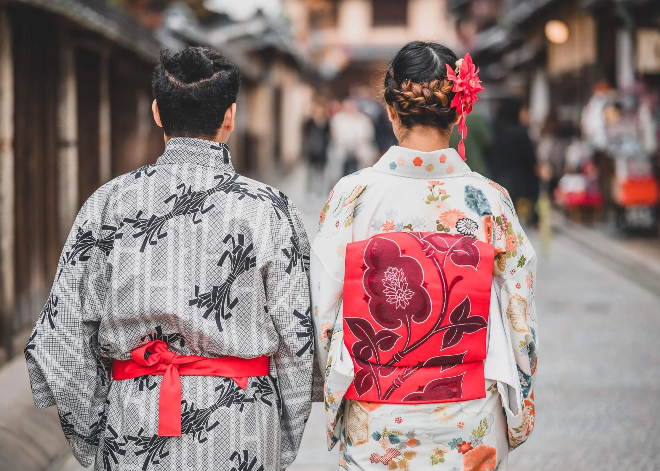
The kimono's progenitor was born during the Heian era (794-1192). Straight cloth slices were sewn together to make a garment that fits everybody's form. It was simple to put on and infinitely customizable. It had developed into a unisex outer garment known as kosode by the Edo period (1603-1868). The kosode, which literally means "little sleeves," was distinguished by smaller armholes. Only after the Meiji era (1868-1912) was the garment referred to as kimono. This most recent transition, from the Edo period to modern Japan, is remarkable.
First Shogun Tokugawa consolidated Japan into a feudal shogunate in the early 1600s. Edo renamed Tokyo in 1868, was now Japan's capital. The resultant Edo Period (also known as the Tokugawa Period) lasted for 264 years. The period from 1603 to 1868 is regarded as the final era of traditional Japan. Throughout this period, Japanese culture flourished with little outside influence. And the kosode was a vital component of what it meant to be Japanese.
During the Edo period, kosode was a visually uniting cultural sign. It was worn by every Japanese citizen, regardless of age, gender, or socioeconomic status. When a Japanese individual came into touch with a foreigner, one obvious difference was that outsiders did not wear kosode. Edo kosode is therefore a glimpse into a civilization shortly before a dramatic transformation.
Since kimonos are frequently passed down through generations, the garment may be exceedingly costly, sometimes costing several hundred pounds. This is because it is historically constructed of expensive fabrics like silk and linen, as well as the fact that its seams and edges must be completed by hand. Nevertheless, the most expensive alternatives are normally held for special occasions, and a casual cotton variant (yukata) is now available across Japan.
While kimonos are popular among fashionistas worldwide, they are also associated with etiquette in Japan and can represent an occasion’s formality. Wearing suitable attire for the occasion is a means of expressing respect and thanks. Rank, formality, and prestige may also be represented by the style, styling, and colour of the kimono, as well as the way the obi is knotted at the back. Kimonos should also be worn with the left side over the right: only a corpse prepared for burial should be dressed with the right side over the left.
Events when Kimonos are Worn
Following the birth of a kid in the family
Between 30 and 100 days following the birth of a child, the parents and grandparents go to a shrine to report the kid's birth. The infant wears a white under-kimono. On top of it, the infant wears a vividly coloured yuzen kimono if she is a girl, and a black kimono with the family crest if she is a male.
The Shichi-Go-San ("seven-five-three") festival, which takes place on November 15, is another important milestone in a child's life. Parents accompany their five-year-old males and seven-year-old or three-year-old girls to the local shrine on this day to thank the gods for keeping their children well and growing.
Coming-of-Age and Wedding Ceremonies
On Coming-of-Age Day, the second Monday in January, young people commemorate their passing into adulthood by visiting a shrine. Girls wear furisode (kimono with long flowing sleeves) and boys wear haori (half-coats) and hakama ornamented with their family crests on this event.
Furisode is only worn by unmarried ladies. Once upon a time, young Japanese ladies proclaimed their love for a guy by flapping their furisode's long-flapped sleeves.
A bride wears a shiromuku, or pure white kimono, to a wedding. The colour white represents the start of a journey.
Tomesode
A lady who is married no longer wears a furisode. She instead wears a tomesode, which is a kimono with shorter flaps on the arms. There are black and colourful tomesode, so named because they have shorter sleeves than furisode. Black tomesode with the wearer's family crest is designated for ceremonial events such as relatives' weddings. Colourful tomesode can be worn at formal events as well. Tomesode (both black and other colours) are distinguished by the fact that only the cloth on the bottom half of the kimono is embellished with a design.
Yukata
In the summer, people wear yukata, or casual summer kimonos, to fireworks displays and summer festivities. Yukata was once worn at home after coming out of the bath, but they are now mostly a staple of the summer cityscape, where they are worn by both young and elderly, male and female. The majority of yukata is made of cotton. Traditionally, they are patterned in navy-on-white or white-on-navy, although new colourful designs have evolved in recent years.
Whatever the occasion—the first shrine visit of the new year, a visit to see an elderly relative, or whatever—Japanese people always consider the season when choosing the colour or design of kimono to wear. Light hues like light green are ideal for spring, whilst cool colours like lavender or dark blue are appropriate for summer. Fall colours should mimic the shades of changing leaves, whereas winter colours should be bold, such as black and red.