Kaizen and Jugaad: An Indo–Japan Model for Frugal Innovation
Posted on: 24 Sep 2025
in Editorials & Opinions
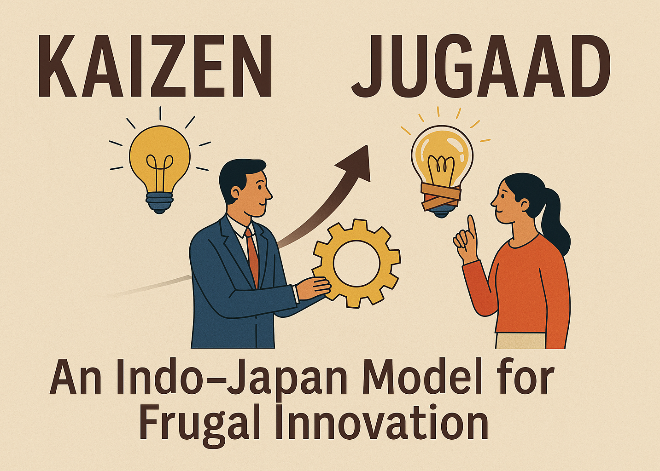
Innovation has long been associated with national signatures. For Japan, it is Kaizen — the quiet, disciplined pursuit of continuous improvement. For India, it is Jugaad — the ability to improvise under constraints. Both concepts have inspired fascination abroad, but both have also been trapped in stereotypes: Kaizen as rigid perfectionism, Jugaad as clever but unsustainable shortcuts.
Today, as the world confronts climate stress, demographic shifts, and the need for inclusive digital infrastructure, it is time to move beyond these caricatures. India and Japan are uniquely positioned to co-create the next generation of frugal innovation — not as a slogan, but as a practical model for the world.
The Indian Edge: Innovation Under Constraint
India’s culture of frugal innovation was not born from philosophy, but from necessity. Scarcity and limitations forced people to create workarounds, to stretch resources, and to improvise solutions when formal systems failed. This is the soil from which jugaad grew — not as an ideal, but as a survival instinct.
What makes India distinctive is how this necessity has been transformed into a wider culture of ingenuity. Families that repaired rather than replaced, entrepreneurs who built with almost no capital, engineers who learned to optimise on outdated equipment — all have contributed to a mindset of “making do, and making it work.” In many ways, what began as jugaad has now matured into structured models of frugal engineering.
Over time, this instinct has moved from the margins to the mainstream. India’s Mars Orbiter Mission (Mangalyaan) showed how world-class space exploration could be achieved at a fraction of global costs. The Unified Payments Interface (UPI) delivered real-time, secure transactions to hundreds of millions with lean infrastructure. In healthcare, institutions like Aravind Eye Care turned cost pressure into a global model for high-volume, high-quality surgery — scaling jugaad ingenuity into world-class institutions.
India’s challenge ahead is to preserve this spirit of constraint-driven ingenuity, this instinct of jugaad, while embedding it into structured institutions that can consistently deliver reliability at scale.
The Japanese Edge: Precision With Limits
Japan’s strength in innovation has never been speed or improvisation, but precision and process. Kaizen — continuous improvement — is too often reduced abroad to a factory-floor slogan. In reality, it reflects a cultural commitment to discipline, collective responsibility, and refinement over time. This is why Japanese products and systems have earned global trust.
But discipline has a cost. Japan’s innovation system has sometimes struggled with affordability and with the risk appetite needed to scale new industries quickly. A hydrogen engine or semiconductor fab of world-class quality can remain commercially out of reach if not designed for wider adoption. Kaizen ensures reliability, but it can also make change incremental when the world sometimes demands leaps.
And yet, when I sit with Japanese SME leaders in Nagoya or Okayama, I hear a remarkable humility: “We can design the best EV part in the world — but not at India’s price point.” That honesty, paired with India’s agility — and its tradition of jugaad improvisation — is the ground on which a new innovation ethic can be built.
Why the Next Generation Needs a Fusion
The coming decades will test humanity in ways that no single model of innovation can handle. Climate change demands affordable green energy and scalable adaptation tools. Ageing populations require low-cost but precise diagnostics, assistive technologies, and eldercare systems. The digital divide needs secure, inclusive infrastructure for billions, not millions.
Here, India’s frugal scale and Japan’s disciplined process are not opposites — they are complements. Together, they can produce solutions that are affordable, sustainable, and globally trusted.
Some early signs of this are already visible. Daikin India has localised R-32 inverter air conditioners for the Indian market, emphasising energy efficiency and lower climate impact. Maruti Suzuki has begun EV production in Gujarat and already started exports of its first model, positioning India as a hub in its global EV strategy. And NEC’s multimodal biometric backbone for Aadhaar shows how Japanese process discipline can reinforce Indian scale to deliver trusted digital infrastructure for over a billion people.
These projects are not yet labelled as “frugal innovation,” but they point toward the kind of Indo–Japan collaboration that could redefine the Kaizen–Jugaad model for the 21st century.
Towards a Frugal Innovation Ethic
If India and Japan are serious about shaping the future of innovation, they should treat it not only as industrial competition, but as a shared responsibility to set standards for the Global South.
This can be anchored in three moves, building on lessons from Daikin, Suzuki, and NEC.
- Frugal Innovation Hubs
Joint centres in Pune and Osaka, Bengaluru and Nagoya, where entrepreneurs and researchers co-develop affordable, high-quality solutions in healthcare, green energy, and mobility. - University–Industry Platforms.
New programs between IITs, IIMs, Keio, and Kyoto University to incubate “frugal-with-precision” startups — pairing Indian agility and jugaad instincts with Japanese rigour in process. - Exporting Inclusive Models
Scale India–Japan solutions in ASEAN and Africa, where demand for reliable but affordable infrastructure is immediate. Projects like Daikin’s ACs, Maruti Suzuki’s EVs, and NEC’s Aadhaar system show how this fusion can deliver practical, trusted models abroad.
This is less a compact than an ethic of innovation — one that refuses waste, values affordability, and aspires to dignity at scale.
A Fresh Reflection
In Pune, I meet start-ups that stretch one rupee of capital further than most investors think possible. In Osaka, I meet engineers who take pride in refining a single process until it is reliable for decades. These are not contrasts, but complements. When connected, they reveal what innovation could mean in an era defined by constraints: not abundance, but sufficiency with dignity.
Together, Kaizen and Jugaad can define an Indo–Japan model of frugal innovation the world urgently needs.
------
About the Author: Mr. Siddharth Deshmukh is the President of the Indo-Japan Business Council (IJBC). He has been a catalyst for bilateral engagement, focusing on economic synergies and cultural exchanges. His leadership has solidified IJBC’s role as a pivotal platform for enhancing connectivity, trust, and cooperation between India and Japan. His re-election underscores his significant contributions to fostering collaboration.
Disclaimer: The views expressed are the author’s personal reflections, shared as part of IJBC’s ongoing work to deepen understanding of the India–Japan partnership.