Beyond Alignment: Making India–Japan Partnerships Work in Practice
Posted on: 28 Jun 2026
in From President's Desk
The relationship has matured at the top. It must now prove itself at the level where business decisions are actually made.
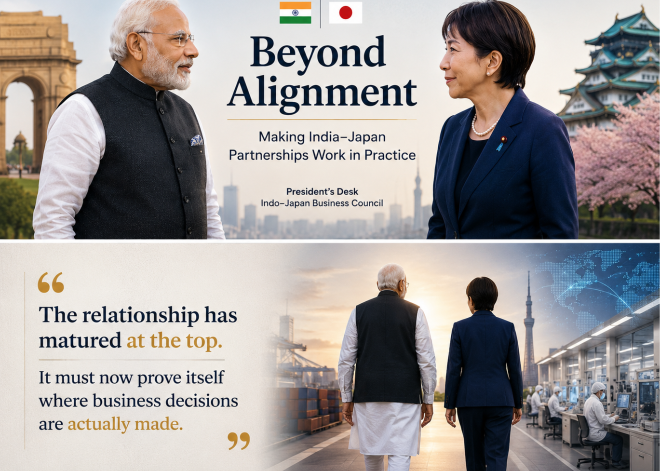
Japanese Prime Minister Sanae Takaichi’s visit to New Delhi from 1–3 July 2026 for the 16th India–Japan Annual Summit comes at an important moment in the relationship.
India and Japan no longer need to prove that their partnership is strong. That has already been established over decades through patient diplomacy, large infrastructure projects, development cooperation, sustained investment, and a shared strategic outlook. The scale of long-term commitment—including the target of 10 trillion yen in Japanese investment into India—reflects this depth of confidence.
The more relevant question today is simpler, and more practical.
Can this relationship now work at the level where business decisions are actually made?
Can it move beyond flagship projects and policy alignment into everyday economic life—into SMEs, supply chains, factories, classrooms, and regional industries?
Because for many businesses on both sides, the opportunity is visible—but the path is not always clear.
Encouragingly, this shift is already visible. More Indian companies are exploring Japan not only as a market, but as a long-term business partner. Japanese firms, including SMEs, are also beginning to look beyond large Indian corporates and engage with mid-sized enterprises and regional ecosystems. This widening of interest is a quiet but important change.
This is also happening in a broader context where both countries are placing greater emphasis on supply chain resilience and trusted economic partnerships. That creates new space—but also raises the bar for participation.
Across our engagement at the Indo-Japan Business Council, we see a more nuanced reality.
Indian SMEs are not asking whether Japan is relevant. They are actively looking for entry—into supply chains, into technology partnerships, into long-term relationships. What they often lack is not intent, but clarity: What standards are expected? How does one qualify? Where does the first serious opportunity come from?
On the other side, Japanese SMEs are increasingly exploring India with interest, but with caution. Their question is not about potential. It is about execution: Can I identify a reliable partner? Can I operate with consistency? Will the business environment support long-term planning?
This asymmetry is important. It shows that the relationship is not static. Movement has begun on both sides. But the pathways are still not well structured.
Significantly, Recent bilateral outcomes also recognise that greater cooperation between small and medium enterprises will be central to the next phase of the partnership. The real task now is to ensure that this direction translates into practical business outcomes.
The relationship has matured at the top. It must now prove itself at the level where business decisions are actually made.
Take the question of trust.
Large corporations have systems, advisors, and time to conduct due diligence. Smaller companies do not. For them, one wrong partnership can set them back by years. In such an environment, the absence of credible, industry-backed pathways for verified introductions becomes a real barrier to participation.
Trust, in this context, is not a sentiment. It is infrastructure.
Trust alone, however, is not enough. Businesses also need predictability.
Japanese companies bring a deep respect for process, continuity, and quality. Indian companies bring agility, adaptability, and market understanding. These strengths can work well together—but only when operating conditions are clear.
When compliance expectations are unclear, when timelines are uncertain, or when interpretations vary, even well-intentioned partnerships slow down. This is not unique to foreign investors; Indian businesses face the same friction.
There is growing recognition that strengthening quality and standards ecosystems will be essential if more enterprises are to participate meaningfully in Japanese value chains.
Then comes capability. India has talent in abundance. What both countries now need is talent that is ready to work confidently across the two business cultures.
India has talent at scale. Japan has demand at scale. But connecting the two requires more than language training or placement programmes.
Working effectively in a Japanese environment requires familiarity with quality systems, reporting discipline, safety standards, and consistency of output. At the same time, Japanese organisations operating in India must adapt their practices to engage effectively with Indian teams.
This is not a one-sided adjustment. It is a shared learning process.
If the next phase of India–Japan cooperation is to be meaningful, the focus must shift from placement to preparation—from movement of people to development of capability.
This becomes even more important when we consider regional India.
The future of this partnership cannot remain concentrated in a few major cities. It must extend to industrial clusters and emerging centres across the country—where manufacturing, education, and entrepreneurship are already evolving.
Eastern India and the Northeast, in particular, hold long-term relevance—not only in terms of connectivity and logistics, but as part of a broader Asian engagement framework.
Ultimately, the test of this relationship is not how many agreements are signed, but how many of them translate into working partnerships.
Too often, meetings happen, intent is expressed, and then momentum fades. The gap between conversation and execution is where many opportunities are lost.
This is where institutions must play a more active role.
A bilateral chamber cannot replace government, and it should not try to. It cannot replace companies either. But it can help create continuity—by supporting SMEs, enabling credible connections, and staying engaged beyond the first interaction.
India and Japan have built a relationship based on trust, and that trust was not created overnight.
The responsibility now is to make that trust usable.
The success of the next decade will not be measured only by investment or alignment. It will be measured by whether more businesses can participate, more professionals can engage, and more regions can benefit.
The direction may be set at the summit level.
But the real progress will be visible only after the summit—when businesses return to their desks, and decide whether to move forward.
India and Japan do not need a new beginning.
They need a more practical middle.
About the Author: Mr. Siddharth Deshmukh is the President of the Indo-Japan Business Council (IJBC). He has been a catalyst for bilateral engagement, focusing on economic synergies and cultural exchanges. His leadership has solidified IJBC’s role as a pivotal platform for enhancing connectivity, trust, and cooperation between India and Japan. His re-election underscores his significant contributions to fostering collaboration.
Disclaimer: The views expressed are the author’s personal reflections, shared as part of IJBC’s ongoing work to deepen understanding of the India–Japan partnership.